How an Induction Sealing Machine Works
A non-contact seal made by heating a foil liner inside a closed cap. Here is what happens, step by step, with a simple diagram.
The principle in one paragraph
An induction sealing head carries a coil. When the machine runs, an alternating current in the coil sets up an electromagnetic field below the head. The field passes through the plastic cap without heating it, but it does heat a metal layer: the aluminium foil of the induction wad inside the cap. The foil warms in a moment, the heat-seal layer on its underside melts against the bottle rim, and when the bottle leaves the field the layer cools and holds the foil to the rim. Nothing touches the bottle, and the product inside is not the target of the heat.
What is inside the cap
The wad is a layered liner. The working layers are the aluminium foil, which takes the heat, and the heat-seal coating facing the bottle, which bonds. Many wads also carry a backing above the foil that stays in the cap after the foil is sealed, so the customer finds a peel-off foil on the bottle and a liner in the cap. The exact build depends on the wad, so take the specification from your cap supplier and tell them the container material.
Step by step on the machine
- Fill and cap: the cap is tightened so the wad presses evenly on the rim.
- Into the field: on the IS100 the head is held over the cap; on the IS200 the bottle rides under the head on a conveyor.
- Foil heats: the field heats only the metal foil.
- Layer melts: the heat-seal coating flows onto the rim.
- Out of the field: the layer cools and the foil stays bonded.
Why tightness, rim and speed matter
The bond forms only where the foil is pressed against the rim, so a loose cap leaves gaps. Oil or syrup on the rim stops the layer from wetting the glass or plastic. Time under the field matters too: on the IS200 the conveyor speed, 2 to 12 metres a minute, and the cap size decide how long each cap spends under the coil; on the IS100 it is how long the head is held. Too little time leaves a weak bond; the first bottles of each batch should be peel-tested.
Hand-held or conveyor: same principle
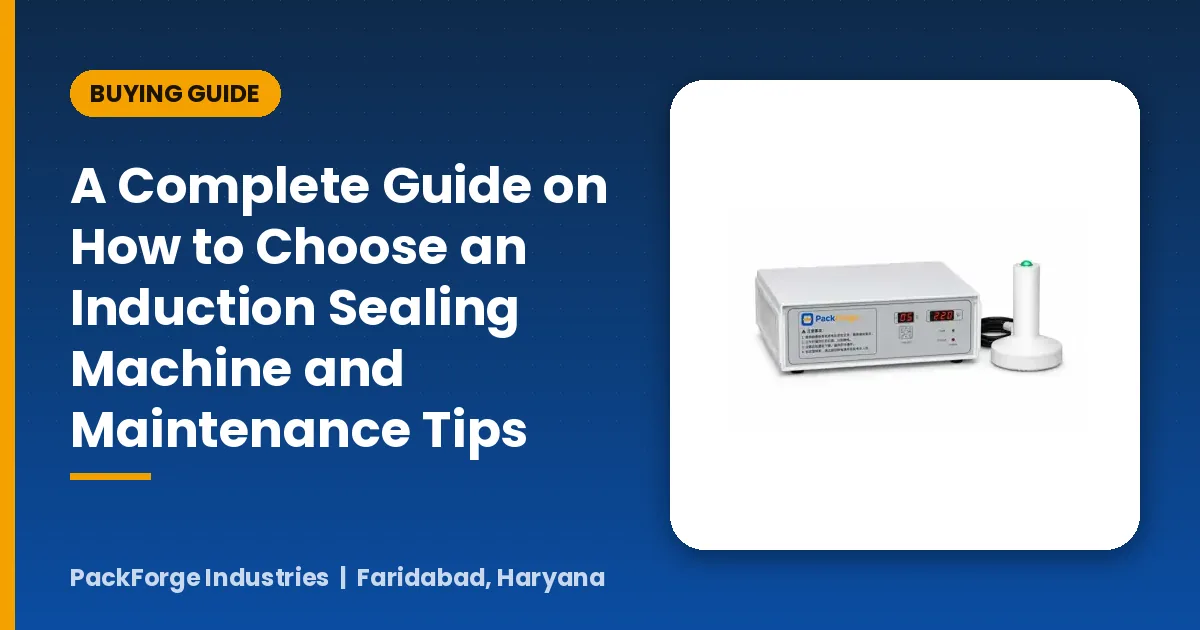
The IS100 and IS200 work on exactly the same principle. The difference is how the bottle meets the field: you bring the head to the cap, or the conveyor brings the cap to the head. The IS100 has no limit on bottle height and handles caps of 20 to 135 mm in its largest version; the IS200 takes bottles 40 to 400 mm tall and caps of 20 to 130 mm, and its coil is water-cooled so it can run through a shift.
Which one suits your line, with rates, is on the induction sealing machine page; wads and caps are covered on induction wad sealing, and choosing and care in the buying guide.
Signs that the principle is working
A good induction seal shows three things when the foil is peeled: it comes away in one piece, it covers the whole rim, and the rim shows an even ring where the layer was bonded. A patchy ring points to an uneven cap or a dirty rim; a foil that lifts without effort points to too little time under the field; a scorched foil to too much.
What induction sealing does not do
It does not tighten the cap, so a capper comes first on the line. It does not seal a cap without a foil wad. And it is a closure seal for bottles and jars; pouches, cups and cans are closed by other machines – band or impulse sealers, a cup sealer, or the ECS150 can sealer.
Frequently Asked Questions
How does an induction sealer heat the foil?
A coil in the head creates an alternating electromagnetic field that heats the metal foil in the cap; the plastic cap is not heated by it.
Does the induction sealer touch the bottle?
No. It is a non-contact process; the bottle only passes under or is held under the head.
Why must the cap be tight before sealing?
The foil bonds only where it is pressed against the rim. A loose cap leaves gaps in the seal.
Is the working principle different on the IS100 and IS200?
No. Both heat the foil with an electromagnetic field; one is hand-held, the other uses a conveyor.
Can induction sealing seal a cap without foil?
No. Without the foil there is nothing for the field to heat.