Induction Wad Sealing Machine Guide
Induction wad sealing bonds a foil liner inside the cap to the rim of the bottle, without touching the bottle. This guide covers the wad, the cap and the machine.
What an induction wad is
An induction wad is a liner that sits inside the cap. Its working part is a layer of aluminium foil with a heat-seal coating on the side that faces the bottle. When the capped bottle passes under an induction head, the electromagnetic field heats the foil; the coating melts onto the rim; and when the field is removed the foil stays bonded. The customer later peels it off – which is the tamper evidence.
The machine cannot make a seal without the wad. A plain cap with no foil liner will not seal, however long it stays under the head.
Because the field heats only the foil, the product inside is not cooked or melted, which is why the same method seals oils, syrups, agro-chemicals and cosmetics. The cap and the wad are the parts that change from one product to the next; the machine stays the same.
What to ask your cap supplier
- Is the liner an induction wad? Say clearly that the caps will go under an induction sealer.
- Which bottle material is it made for? The heat-seal coating has to bond to your container, so tell the supplier what the bottle is made of.
- Will it peel cleanly? Ask for a sample batch and peel-test it on your own bottles.
- Cap diameter and torque: the wad bonds only when the cap presses it evenly onto the rim.
PackForge does not sell wads or caps; we supply the machines. Send a cap and liner sample with your enquiry and suitability can be checked.
The wad sealing machine: IS100 or IS200
The IS100 is held over each cap and has no limit on bottle height. It is sold in three cap ranges – 20 to 80, 20 to 100 and 20 to 135 mm – from ₹4,999 + ₹900 GST. The IS200 seals capped bottles 40 to 400 mm tall on its own conveyor at 2 to 12 metres a minute, caps 20 to 130 mm, from ₹58,240 + ₹10,483 GST. Both are compared in full on the induction sealing machine page.
The order on the line
- Fill the bottle, keeping the rim clean and dry.
- Cap it with the wad inside, tightened evenly – by hand or with a capper such as the CL40.
- Induction seal under the IS100 or IS200.
- Peel-test the first bottles of every batch.
Capping comes before sealing because loose caps do not press the wad onto the rim.
Keep the time between capping and sealing short on a line, so caps are sealed while the rims are still clean.
When the wad does not bond
Loose cap: the commonest cause; check the tightening first. Wet or oily rim: oil or syrup on the rim stops the coating bonding. Wrong wad: a liner meant for another container may not bond to yours. Head position: centre the IS100 over the cap; on the IS200 match speed and guides to the bottle. Cap outside the range: check your largest cap against the version you bought.
Wad sealing compared with other closures
Induction sealing is one of several ways to close a container, and the right one depends on the pack:
- Screw cap only: tightened by hand or by a capper; no inner seal and no tamper evidence on its own.
- Screw cap plus induction wad: the cap is tightened, then the wad is bonded – the usual choice for oil, syrups and agro-chemicals.
- Crown cork: crimped onto glass soda bottles by the PCC crown capper.
- Metal can lid: double seamed by the ECS150 on ghee, oil and food tins.
- Film lid on a cup: pressed on by the manual cup sealing machine.
Setting up and testing
Before a full run, seal a handful of bottles and peel every foil: it should come away cleanly and cover the whole rim. Try the shortest and the tallest bottle you fill, and the largest and smallest cap. On the IS200, set the conveyor speed to the cap size and the guides to the bottle so each cap passes straight under the coil. On the IS100, hold the head centred and still for the same moment on every cap.
Keep a record of the setting that works for each bottle and cap, and repeat the peel test at the start of every batch. If foils begin to lift at the same settings, check cap tightness and the rim before changing anything on the machine.
Wad sealing for different products
Edible oil: the foil stops seepage in transit even if a cap loosens; keep the rim free of oil at filling. Pharma and Ayurvedic syrups: the peel-off seal shows the bottle is unopened. Agro-chemicals and pesticides: a bonded liner keeps the contents in during rough handling. Cosmetics and hair oils: a clean inner seal that customers recognise. Pickles and food jars: wide caps are within reach of the IS100 in its 20 to 135 mm version.
Who uses wad sealing
Edible oil packers, pharma and Ayurvedic syrup makers, agro-chemical bottlers, cosmetic and hair oil brands and food packers sealing jars. The induction sealing machine buying guide walks through choosing and caring for the machine.
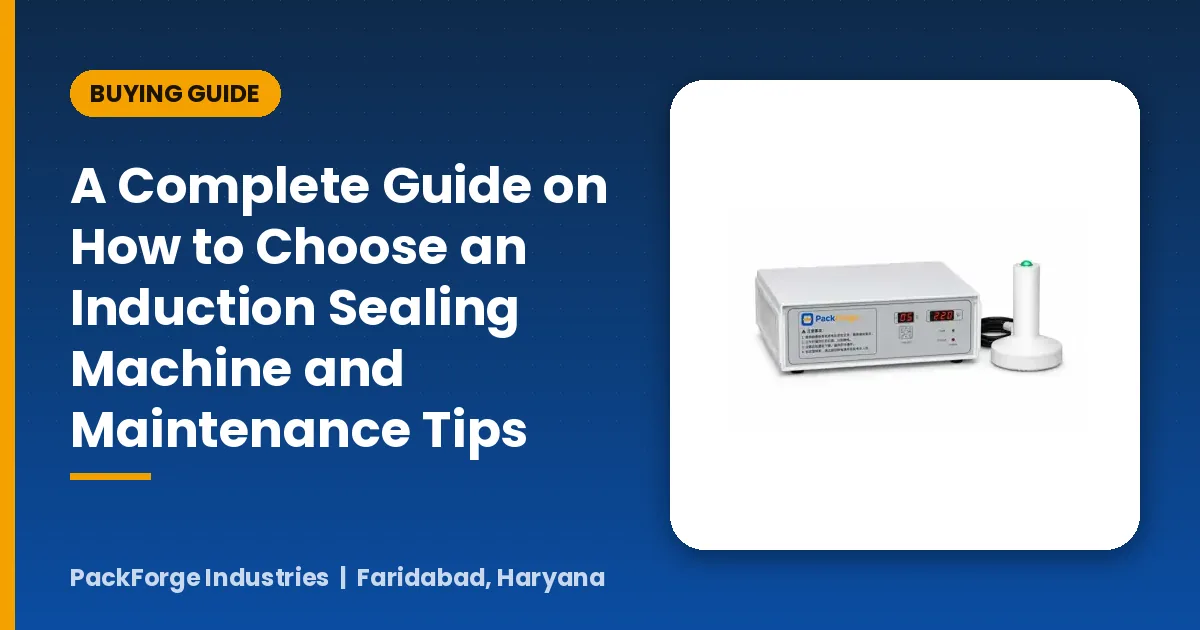
For the physics behind the seal, see how an induction sealing machine works.
Frequently Asked Questions
What is induction wad sealing?
Bonding the foil liner inside a cap to the bottle rim by heating the foil with an electromagnetic field. It gives a tamper-evident, leak-proof inner seal.
Can any cap be induction sealed?
Only caps with an induction wad inside. A plain cap without a foil liner will not seal.
Does PackForge sell induction wads?
No. Wads come inside the caps from your cap supplier; PackForge supplies the IS100 and IS200 machines.
Why does the wad lift on some bottles?
Usually a loose cap, a wet or oily rim, or a wad meant for a different container.
Which wad sealing machine should I buy?
The hand-held IS100 for bench work and any bottle height; the conveyor IS200 for a running line.