Semi Automatic vs Automatic Carton Sealer
Both kinds of sealer put the same tape on the same box. The difference lies in who sets the machine for each carton, what it needs in air and money, and how much of your carton mix it can take without stopping.
Semi automatic vs automatic carton sealer at a glance
All figures below come from the published specifications of PackForge models. Semi automatic here means the compact, PF-SAC-01, 102TUS and 102TU; automatic means the 102TR, the automatic random sealer and the 5050Z flap folder.
| Point | Semi automatic | Automatic |
|---|---|---|
| Who sets width and height | Operator, once per carton size | The machine, for every carton (102TR, random) |
| Published output | PF-SAC-01 about 800 to 1,200 cartons an hour on one size; 102TU 20 a minute | Random model about 500 to 700 an hour with sizes mixed; 5050Z up to 25 a minute |
| People at the machine | One, who folds flaps, feeds and resets | One, who feeds; the 5050Z also folds the flaps |
| Compressed air | Not needed | Needed: 2 / 3 litre at 5 bar (102TR), 5 to 6 bar (random), 0.4 to 0.6 MPa (5050Z) |
| Best carton mix | One to three regular sizes | Sizes that change through the day |
| Power | Single phase, about 0.2 to 0.24 kW (compact, PF-SAC-01) | 220 W (102TR); about 0.4 kW plus air (random) |
| Weight | 100 to 140 kg (compact, PF-SAC-01); 133 kg (102TU) | 150 kg (102TR); 250 kg (5050Z); about 250 to 300 kg (random) |
| Price from | ₹57,500 + ₹10,350 GST (compact) | ₹2,50,880 + ₹45,158 GST (102TR) |
Which three questions decide it?
- How many carton sizes run for a real part of the day? Count only sizes that run longer than a few minutes. Three or fewer points to semi automatic with a short changeover; a wide, shifting mix points to automatic.
- Is compressed air available at the packing spot? If not, and no compressor is planned, stay with semi automatic. Every automatic model in our range needs air.
- Is flap folding or manpower the bottleneck? If people folding flaps hold the line back, the 5050Z folds all four top flaps itself and takes one operator off the line.
If your answers point both ways, send us the carton list and your busiest hour's count. We will say which level fits, including when the cheaper machine is enough.
What does semi automatic mean on a carton sealer?
The taping itself is automatic on both types: belts pull the box through and the heads apply, press and cut the tape. Semi refers to the setting. On these machines a person moves the side guides and the top head to suit the carton, then runs boxes of that size until the next change.
The reset is a manual job at the handles, and marking your regular positions on the frame makes it quicker. A PF-SAC-01 can even arrive pre-set if you share your carton size when ordering. The range covers the compact model, the PF-SAC-01 top and bottom sealer, the 102TUS for small boxes and the 102TU; all are grouped under semi automatic carton sealing machines.
What makes a sealer automatic?
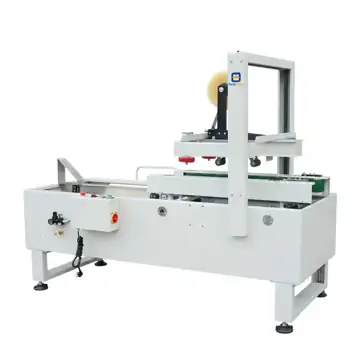
An automatic random sealer senses each carton as it arrives and moves its guides and top head to suit, using compressed air. Nobody touches a handle between a small box and a large one. The PackForge 102TR does this pneumatically for boxes between its listed 180 x 100 mm and 500 x 500 mm, at a belt speed of 24 metres per minute. The automatic random carton sealing machine is built around mixed-order fulfilment.
A different kind of automation is flap folding. The 5050Z flap folder sealer closes the four top flaps before taping, so the operator only feeds a filled, open carton. For a full picture of this class, see our automatic carton sealing machine page.
Is an automatic sealer always faster?
Not on a single size. The PF-SAC-01 is published at about 800 to 1,200 cartons an hour on one carton, while the automatic random model is quoted at about 500 to 700 an hour with sizes mixed. Belt speeds are close too: about 20 metres per minute on the semi automatic models against 24 on the 102TR.
The automatic gain comes from the resets it removes. To see whether that matters on your floor:
- Time one changeover on your current bench, from last box of one size to first good seal on the next.
- Count the size changes in a typical shift.
- Multiply the two. That is the time a self-adjusting sealer gives back each shift.
If the answer is a few minutes, semi automatic wins. If it is an hour or more, automatic deserves a close look.
How do staff and air needs compare?
Staff. Both types need one person to feed. On a semi automatic machine that person also resets sizes, so they need a little more training; on an automatic random sealer, a new hand can feed mixed boxes from day one. Only the 5050Z removes a job altogether: it folds the flaps, which PackForge lists as saving one operator.
Air. This is the hidden cost of automatic machines. If your unit has no compressor, budget for one, its piping and its power before ordering. Dry, filtered air at a steady pressure matters as much as the figure on the gauge, and a compressor shared with other tools can starve the sealer at busy times. Semi automatic models avoid the question altogether.
How big is the price gap, and when does it pay back?
Take the two models compared most often. The PF-SAC-01 costs ₹69,730 + ₹12,551 GST and the 102TR ₹2,50,880 + ₹45,158 GST, a gap of ₹1,81,150 + ₹32,607 GST. Add a compressor if you have none.
Payback is that gap divided by the monthly value of time saved on changeovers, plus any reduction in staff at the bench. On a line with many daily size changes the sum can work quickly; on one dominant size it may never work, and the money is better spent on a second semi automatic bench. All rates sit together on the carton sealing machine price page.
Which PackForge model sits where?
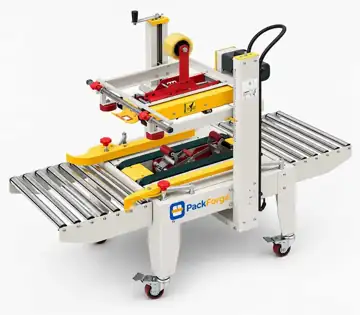
- Semi automatic: compact sealer ₹57,500 + ₹10,350 GST; PF-SAC-01 ₹69,730 + ₹12,551 GST; 102TUS for small cartons ₹98,560 + ₹17,741 GST; 102TU for standard cartons ₹1,07,520 + ₹19,354 GST.
- Automatic size setting: 102TR ₹2,50,880 + ₹45,158 GST; automatic random sealer ₹3,19,270 + ₹57,469 GST. Both are in the automatic random range.
- Automatic flap folding: 5050Z ₹3,11,808 + ₹56,125 GST.
- Special duty: 102PLS taping and strapping combo ₹4,04,992 + ₹72,899 GST, which needs no air; 5050J edge sealer ₹9,40,800 + ₹1,69,344 GST, which does.
Before choosing, check that your smallest and largest boxes fit; our guide to carton size for sealing machine models lists the published limits.
Start semi automatic and add automatic later?
Many units begin with a semi automatic sealer for their main carton. When online orders or new products widen the mix, they add an automatic random machine for the mixed line and keep the first one on the main size. Two machines in this pattern often cost less than one automatic sealer forced to do everything.
At very low volume, neither may be needed yet; compare a hand dispenser in carton sealer vs tape dispenser. Every PackForge sealer is manufactured in Faridabad and delivered free across India, about 3 days to metro cities and 5 to 6 days elsewhere. On-site service covers Delhi NCR; other regions get phone or video help and spares by courier.
Questions buyers ask
Which suits an e-commerce warehouse, semi automatic or automatic?
It depends on the carton mix, not the business type. A seller shipping mostly one box size does well with semi automatic. A 3PL or marketplace seller whose next box is never predictable gains from an automatic random sealer.
Kya automatic carton sealer ke liye compressor zaroori hai?
Yes. The 102TR is listed at 2 / 3 litre at 5 bar, the automatic random model at 5 to 6 bar and the 5050Z at 0.4 to 0.6 MPa. Semi automatic models need only single phase power.
Can a semi automatic sealer run more than one carton size?
Yes, one size at a time, with a manual reset of width and height between sizes. If more than three sizes run regularly through the day, an automatic random sealer is worth comparing.
Is the seal from an automatic machine stronger?
No. Both use the same kind of tape heads, rollers and BOPP tape. An automatic machine keeps the setting right for every box, so it removes the risk of a wrong manual setting rather than making a stronger seal.
Can I upgrade a semi automatic machine to automatic later?
Treat them as separate machines. Many units keep the semi automatic sealer for their main carton and add an automatic random one for mixed orders, which also gives a backup if one machine is down.
How much floor space does each need?
Approximate footprints: compact 1,000 x 750 mm, PF-SAC-01 1,020 x 850 mm, automatic random 1,700 x 900 mm and 102TR 1,970 x 660 mm. Leave clear space at both ends for feeding and sealed boxes.
Does an automatic sealer need a skilled operator?
Less setting skill than a semi automatic one, because it sizes itself. The operator still feeds boxes, loads tape, keeps the blade clean and watches the air gauge each day.
Semi automatic or automatic for your line?
WhatsApp your carton sizes, busiest hour's count and whether you have compressed air to +91 95822 69346 or call +91 98184 38346, and we will recommend the level that fits.
More on carton sealing machines
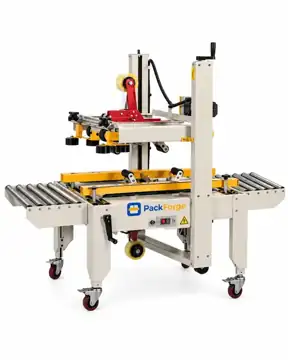 PackForge Compact Carton Sealing Machine for Small Cartons
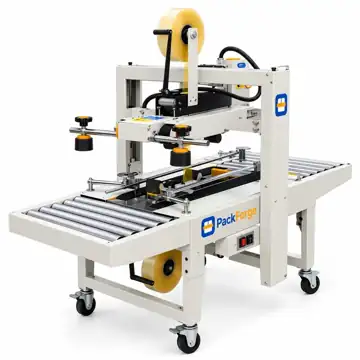 PackForge 102TR Pneumatic Automatic Carton Sealer
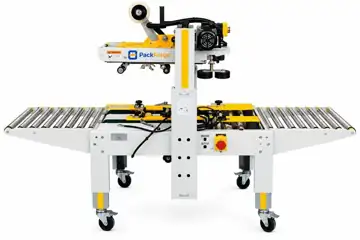 PackForge 102TU Carton Sealer (Standard Carton)
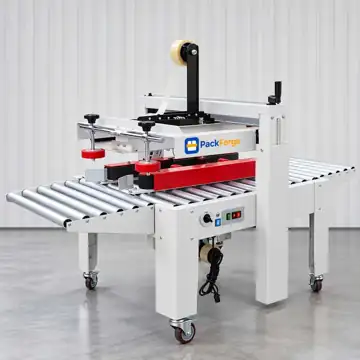 PackForge 102TUS Carton Sealer (Smaller Cartons)
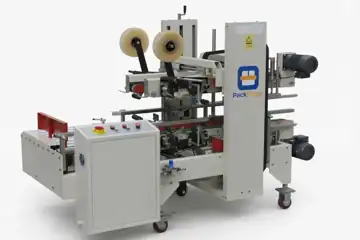 PackForge 5050J Carton Edge Sealing Machine
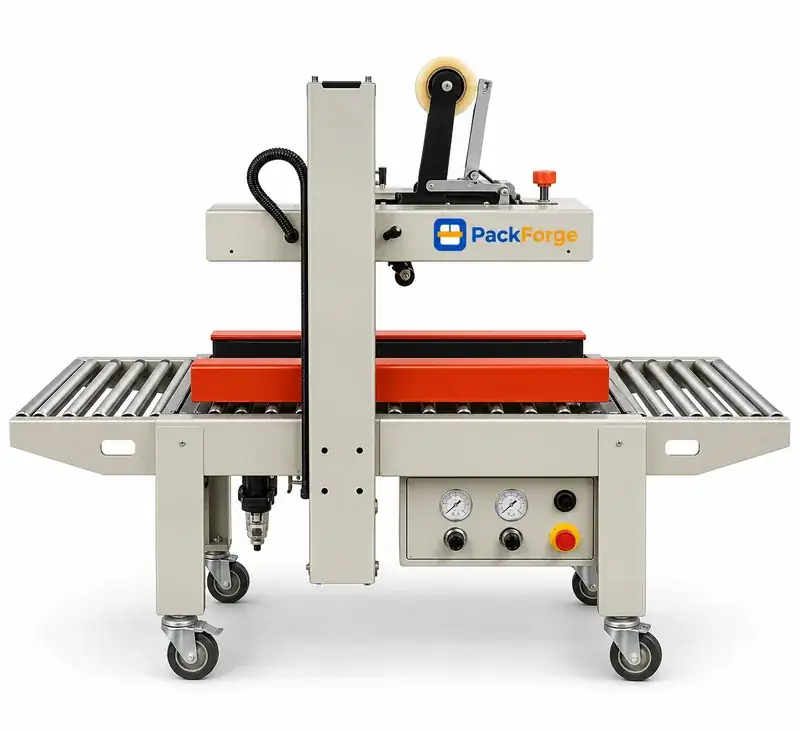 PackForge 5050Z Carton Sealer with Flap Folder