Carton Sealing Machine for Garments and Textile
Garment cartons are light and soft, often a little overfilled, and export ones must follow the buyer's packing rules. Here is how to get a flat, clean seal on them and which PackForge machine fits each kind of textile dispatch.
Why are garment cartons different from other loads?
Garments are light and soft. A carton of folded shirts weighs little for its size, so the seal rarely fails from weight. It fails for other reasons:
- Over-filling. Packers fit one more polybag into the box, the top bulges, and the flaps no longer meet.
- No firm base for the tape. Soft contents give way under the top head, so the tape can wrinkle unless the box is filled evenly.
- Buyer rules. Export buyers often specify the carton size, board, tape width, label position and sometimes straps.
- Marking space. Shipping marks, PO number, carton number and barcode labels all compete for the same faces as the tape.
A carton sealer for textile and garments work therefore has to give a flat, centred seam on a soft box, and leave the marking areas clear.

Overfilled soft cartons: how do you get a flat seal?
Most garment seal complaints start before the machine. A carton that bulges by even a finger's width pushes the seam apart, and tape laid across a gap between flaps peels from the middle.
- Pack to a count that fits. Fix pieces per carton for each style so the top closes flat without pressing.
- Press bundles before boxing. Bundling folded garments under even pressure, often with a strap, makes them take less room and keeps the top flat.
- Set the top head lightly. On a semi automatic sealer the top head should just touch the closed box. Lowering it to squash a bulge creases the tape and crushes corners.
- Close flaps edge to edge. The two long flaps should meet in a straight line along the centre before the carton enters the belts.
Once these are right, a fixed-size sealer gives the same flat seam on the last box of the shift as on the first.
Which garment carton suits which PackForge model?
Rates exclude 18% GST; model names link to full specifications.
| Garment carton | Size check | PackForge model | Rate + 18% GST |
|---|---|---|---|
| Domestic dispatch, one standard carton most of the day | Send your carton size with the order and the machine is set before dispatch | Semi automatic carton sealing machine | ₹69,730 + ₹12,551 GST |
| Export carton where the buyer asks for 2-inch or 3-inch tape | From L150 x W170 x H110 mm; width and height up to 500 mm | 102TU | ₹1,07,520 + ₹19,354 GST |
| Small boxes for single garments or accessories, low volume | Footprint near 1,000 x 750 mm | Compact carton sealer | ₹57,500 + ₹10,350 GST |
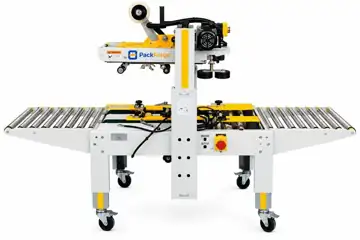
| Export carton that needs an H-seal | Between 320 x 200 x 180 mm and 500 x 500 x 500 mm | 5050J edge sealer | ₹9,40,800 + ₹1,69,344 GST |
Many export garment cartons are longer than 500 mm. The 102TU lists its limit as width and height, not length, but a carton that long falls outside the 5050J range. Check your buyer's carton size against the table before ordering. All prices are on the carton sealing machine price page.
Export H-seal: when a buyer's specification asks for it
Some export buyers ask for edge taping on top of the centre seam, giving an H shape on each face. It closes the corners of the seam and makes a carton hard to open without leaving marks, which matters on a long sea or air journey through several handlers.
There are two ways to meet the rule:
- Machine centre seam, edge strips by hand. A fixed sealer tapes top and bottom; a packer adds the end strips with a dispenser. This works for modest export volumes and for cartons longer than 500 mm.
- 5050J edge sealer. One machine lays the centre seam and the edge strips, top and bottom, for packs of 2.5 to 30 kg. It needs air at 0.5 to 0.6 MPa and takes 60 or 76 mm tape.
Read the specification carefully: some buyers fix tape width and colour as well as the pattern. More on export packing is on carton sealing machine for export.
Carton marking space: how do you keep tape off the shipping marks?
A garment export carton carries a lot of print: buyer name, PO and style numbers, colour and size breakdown, carton number, gross and net weight, and often a barcode label in a fixed position. Tape that runs over any of it causes trouble at the buyer's warehouse.
- Centre seam only: the tape covers the flap joint on top and bottom, plus a short leg on each end face. Keep end-face marks clear of the top and bottom edges by more than the leg length.
- H-seal: the edge strips run along the ends of the top and bottom faces. Marks near those edges need to move inward.
- Tape width: 48 mm tape leaves more of the top face free than 3-inch tape. Use the narrower width unless the buyer or the carton weight calls for wider.
- Label position: if the buyer fixes it, check one sealed sample against the specification before bulk packing starts.

Should garment cartons be strapped as well?
Usually, a well-filled garment carton travels fine on tape alone, because it is light. Strap comes in for three reasons:
- The buyer's packing note asks for straps, often two, in set positions.
- Cartons will sit at the bottom of a tall stack in a container or godown.
- Bundles of folded garments are compressed before boxing to save carton space.
Soft cartons crush easily, so keep strap tension low and use edge protectors on printed board. A semi automatic strapping machine beside the sealer handles both carton strapping and bundle pressing.
Home textiles and made-ups: light but bulky
Bed linen, towels, curtains and other made-ups usually leave in cartons; blankets, quilts and rugs are often baled instead. The carton side follows the same rules as garments: pack to a count that closes flat, and keep marks clear of the tape. The bale side is a strapping job, where the strap holds the compression in place for the whole journey.
Panipat is the best-known example in North India, with blankets, rugs and made-ups going across the country and abroad. Units there often need a sealer for cartons and a strapper for bales on the same floor. See packaging machines for Panipat.
Changing styles, changing carton sizes
Garment units pack many styles, and each buyer or size set may come with its own carton. On a fixed-size sealer, each change means resetting width and height. With two or three cartons a day, that takes little time. When the carton changes many times in a day, packers start taping by hand again.
Count how many carton sizes really run for more than a short while each day. With three or fewer, a fixed sealer is the cheaper choice. With more, look at the self-adjusting random sealer on our main carton sealing machine page, which needs compressed air. Garment brands shipping single orders to marketplaces should also read the carton sealing machine for e-commerce page.
Garment and textile hubs we supply from Faridabad
Every PackForge sealer is manufactured in Faridabad and reaches garment units anywhere in India with no delivery charge, in roughly 3 days to metros and 5 to 6 days to smaller towns.
- Tiruppur, Tamil Nadu. India's knitwear export centre, where T-shirts and innerwear leave in buyer-specified cartons. See packaging machines in Tiruppur. Support there is by phone or video, with spares sent by courier.
- Noida, Uttar Pradesh. The industrial sectors hold many garment export units alongside electronics firms. See packaging machines for Noida Sector 63. Noida is in Delhi NCR, so on-site service is available.
- Panipat, Haryana. Home textiles, also within Delhi NCR and on-site service range.
Every sealer ships with a GST invoice and a 12-month warranty on manufacturing defects; belts, blades and rollers count as wear parts. The carton sealing machine buying guide helps with sizing before you ask for a quotation.
Questions buyers ask
Which carton sealing machine for garments is the usual first buy?
For one standard carton most of the day, the semi automatic top and bottom sealer at ₹69,730 + ₹12,551 GST. If the buyer asks for 3-inch tape, choose the 102TU.
Garment carton overfill hone par tape kyun nahi chipakti?
A bulging top pushes the flaps apart, so the tape crosses a gap and peels. Fix the pieces per carton so the top closes flat, and set the top head to just touch the box.
Can the 5050J apply an H-seal on long export cartons?
Only up to 500 x 500 x 500 mm, and at least 320 x 200 x 180 mm. Longer cartons can get the centre seam on a fixed sealer and edge strips by hand.
Do garment cartons need strapping?
Usually not for weight, since garments are light. Strap them when the buyer's packing note asks for it, when cartons sit low in tall stacks, or to press bundles before boxing.
Will the tape cover our shipping marks?
The centre seam covers only the flap joint and a short leg on each end face. Keep marks clear of those areas and check one sealed sample before bulk packing.
Which tape width suits garment cartons?
48 mm suits most light garment cartons and leaves more print space. Use 3-inch tape if the buyer specifies it or the carton is heavy. The 102TU takes both 50 and 76 mm.
Is on-site service available for units in Noida and Panipat?
Yes. Both are in Delhi NCR, where on-site service is available. Units elsewhere, such as Tiruppur, get phone or video help and spares by courier.
Send us your buyer's carton specification
Share the carton sizes, tape width and taping pattern your buyers ask for, plus cartons per day, and we will suggest a model and send a quotation. Phone +91 95822 69346 or +91 98184 38346 (Mon to Sat, 9:30 AM–6:30 PM).
More on carton sealing machines
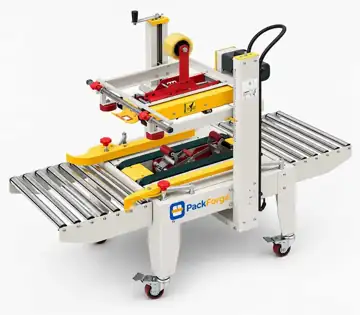 PackForge Automatic Random Carton Sealing Machine, Auto Size Adjust
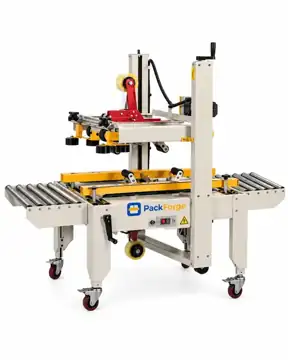 PackForge Compact Carton Sealing Machine for Small Cartons
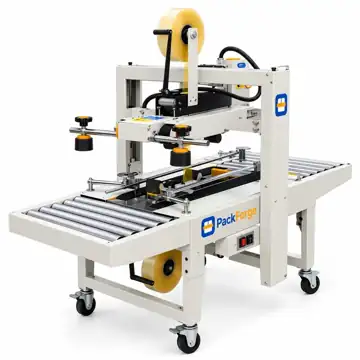 PackForge 102TR Pneumatic Automatic Carton Sealer
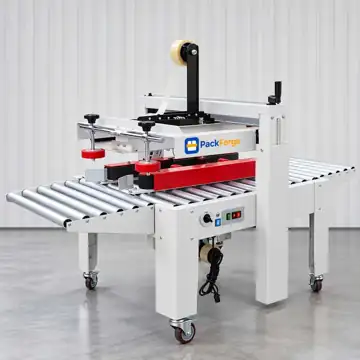 PackForge 102TUS Carton Sealer (Smaller Cartons)
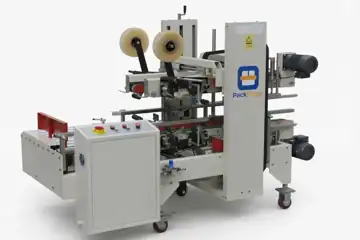 PackForge 5050J Carton Edge Sealing Machine
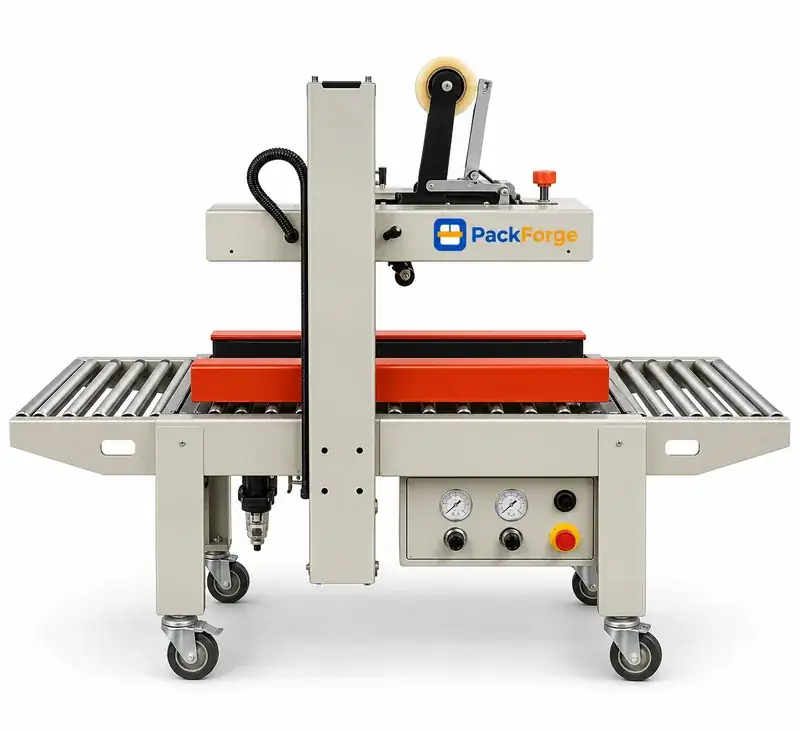 PackForge 5050Z Carton Sealer with Flap Folder
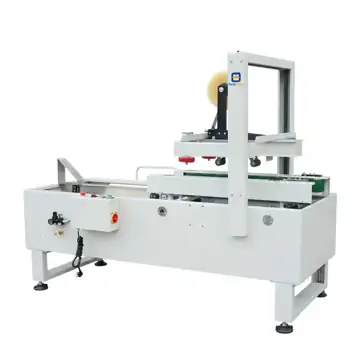 PackForge Semi Automatic Carton Sealing Machine, Top & Bottom Tape