How to Choose a Carton Sealing Machine – Buying Guide
Seven steps to the right carton sealer: measure your boxes, check the fill, count your dispatch, confirm tape, power, air and floor space, then match a PackForge model.
Step 1: measure the full carton range
Collect one of every carton your dispatch section uses, not just the main shipper, and write down length, width and height in millimetres. The smallest and largest figures in each dimension decide which machine can do the job, because every sealer has a lower and an upper size limit.
Published size windows for the PackForge range:
| Model | Smallest carton | Largest carton |
|---|---|---|
| 102TUS | 80 to 90 mm | 500 x 500 mm |
| 102TU | L150 x W170 x H110 mm | W500 x H500 mm |
| 102PLS | L150 x W135 x H130 mm | W500 x H500 mm |
| 102TR | 180 x 100 mm | 500 x 500 mm |
| 5050Z | 180 x 180 x 160 mm | 600 x 500 x 500 mm |
| 5050J | 320 x 200 x 180 mm | 500 x 500 x 500 mm |
For the compact sealer, the semi automatic top and bottom model and the auto size adjust random sealer, send us your sizes and the working window is confirmed on the quotation.
Step 2: look at flaps, fill and carton weight
A taping head needs a flat, closed top to press against. If cartons leave the packing table over-filled, with flaps bowing upwards, no machine will lay a tidy seal, so fix the fill before blaming the sealer.
Watch who closes the flaps today. If a packer is folding four top flaps by hand on every box and that is where the queue builds up, the PackForge 5050Z does that folding itself, and your packer simply pushes in the open, filled box.
Then weigh a few full cartons. Heavy loads going a long way are what edge sealing is for: the PackForge 5050J is meant for loads of 2.5 to 30 kg and sits on a 400 kg frame. At the other end, small, light boxes can slip between the belts of a full-size machine; they belong on the compact model or the 102TUS.
Step 3: work out cartons per hour
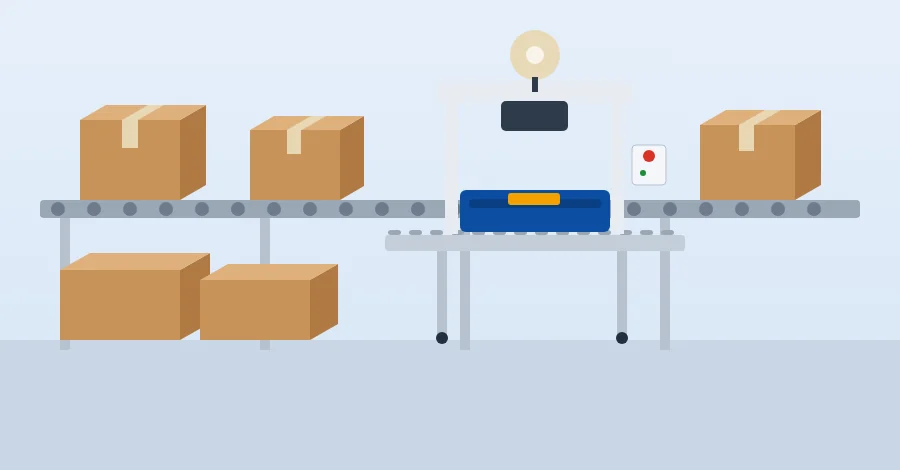
Speed claims mean little until you know your own number. Work it out like this:
- Pull dispatch records for the busiest day of the last few months, such as a sale day or month end, and count the cartons that left.
- Divide by the hours your team actually spent packing, not the hours the gate was open. That is your average per hour.
- Stand at the packing line during the peak hour on a normal day and count again. Size the machine for that peak, not the average.
- While counting, note how many times the carton size changed. Frequent changes push you towards a random sealer.
- Compare your peak with the published output. The 102TU and 102PLS are rated at 20 cartons per minute and the 5050Z at 25 per minute; the semi automatic top and bottom model is listed at about 800 to 1,200 cartons per hour, the compact model at about 800 to 1,000, and the auto size adjust sealer at about 500 to 700 per hour on mixed sizes.
Rated figures assume a steady feed; in practice the packers filling cartons usually set the pace.
Step 4: match the tape width
Check what your stores department buys now. Lighter cartons are commonly sealed with 48 mm (2 inch) BOPP tape, while larger or heavier boxes go to 60 mm or 72 to 76 mm (3 inch). Check your width against the shortlisted model:
- 102TU and 102PLS: 2 inch (50 mm) or 3 inch (76 mm)
- 102TR and 5050Z: 48, 60 or 76 mm
- 5050J: 60 or 76 mm, with BOPP, PVC or water-free adhesive tape
- 102TUS: narrower tape, listed as 36 and 48 mm
Machine-length rolls in these widths are listed under BOPP tape rolls.
Step 5: power and compressed air
All nine models run on a normal 220 to 240 V AC supply, and none of them draws much power: roughly 0.2 kW on the compact model, 200 W on the 102TUS, 220 W on the 102TR and 850 W on the 5050J, the heaviest consumer in the range.
Compressed air is the item buyers forget. Four machines need it:
- 102TR: a small compressor, listed as 2 / 3 litre at 5 bar
- Auto size adjust random sealer: compressed air at 5 to 6 bar
- 5050Z flap folder: 0.4 to 0.6 MPa (4 to 6 bar)
- 5050J edge sealer: 0.5 to 0.6 MPa (5 to 6 bar)
No air line at the packing area? Plan where the compressor will stand before the sealer arrives. The compact, semi automatic, 102TUS, 102TU and 102PLS need no air at all.
Step 6: floor space and table height
Mark the footprint on the floor with tape before you order. Approximate overall length and width: compact model 1,000 x 750 mm, semi automatic 1,020 x 850 mm, 102TU 1,052 x 755 mm, 102PLS 1,373 x 900 mm, auto size adjust sealer 1,700 x 900 mm, 102TUS 1,750 x 880 mm, 5050J 1,955 x 1,060 mm and 102TR 1,970 x 660 mm. Add clear space at both ends for feeding and for sealed boxes.
Working height matters if the sealer joins a conveyor or a packing bench. The 102TU and 102PLS adjust from 570 to 770 mm, the 102TR from 600 to 780 mm and the 5050Z from 600 to 750 mm, while the 5050J has a fixed 750 mm table.
Step 7: match your situation to a model
- One carton size most of the day: semi automatic top and bottom sealer or PackForge 102TU.
- Small boxes, lighter volume: compact carton sealer; for packs down to 80 mm, the PackForge 102TUS.
- Sizes changing all shift: a random sealer, either the PackForge 102TR or the auto size adjust model.
- Flaps folded by hand are the bottleneck: PackForge 5050Z.
- Edge or H-seal needed for transport and tamper evidence: PackForge 5050J.
- Cartons must be strapped as well as taped: PackForge 102PLS.
Range pages group the options: semi automatic, automatic random and compact. Low daily volume? Read carton sealer vs tape dispenser first. Online sellers will find layout tips in carton sealers for e-commerce.
Checklist before you place the order
- Smallest and largest carton written down in L x W x H.
- Number of different sizes that run on the same shift.
- Peak cartons per hour, counted on the line.
- Who folds the flaps now, and whether that step slows the line.
- Heaviest packed carton weight, and how far it travels.
- Tape width and type your store buys.
- Compressed air available at the packing area, or a place for a compressor.
- Floor space marked out, with room to feed and to collect.
- Conveyor or bench height, if the sealer must line up with one.
- Whether cartons also need strapping or edge sealing.
With those ten answers in hand, compare rates on the carton sealing machine price page, or go back to the main carton sealing machine page to see all nine models side by side.
Questions buyers ask
What should I check first when buying a carton sealing machine?
The carton itself. Note the smallest and largest box you seal in all three dimensions and confirm both fall inside the machine's size window. Speed and price come after that.
How do I decide between semi automatic and automatic random?
Count how often the carton size changes during a shift. If one size runs for hours, a semi automatic machine set once is cheaper and simpler. If sizes change every few boxes, a random sealer that adjusts itself saves the reset time.
What happens if my smallest carton is below the machine's minimum?
The belts will not hold it properly and the seal will be crooked or missed. Choose a model with a lower limit, such as the 102TUS, or plan to tape those few cartons by hand.
Do I need a compressor for a carton sealer?
Yes, if you choose a pneumatic model. Four machines use air: the two random sealers, the 5050Z flap folder and the 5050J edge sealer. The rest of the range is purely electric.
How much floor space should I keep for the machine?
Start from the overall size on the product page, then add working room at the infeed and outfeed ends. Taping the outline on the floor before ordering shows quickly whether it fits.
Can a carton sealer fix badly packed boxes?
No. Bulging or sagging cartons will not seal neatly on any machine, so correct the fill at the packing table first.
What details should I send to get a recommendation?
Your carton size range, peak cartons per hour, tape width, carton weight, and whether you have compressed air. With those, we can name the model that fits and quote it.
Not sure which model fits? Ask us
Send the answers from the checklist above on WhatsApp to +91 95822 69346, or call +91 95822 69346 / +91 98184 38346 between 9:30 AM and 6:30 PM, Monday to Saturday. We will recommend one model and tell you plainly if a cheaper one will do.