How to Use a Carton Sealer
Once set for your box, a carton sealer is easy to run. This guide takes a new operator from switch-on to a clean, centred seal, tape loading included.
How to use a carton sealer: the steps in order
Fit the machine to the box first, then the tape, then test. Learning how to use a carton sealer in this order avoids most day-one jams and crooked seals.
- Make the machine safe.
- Check the carton.
- Set the width.
- Set the top head height.
- Load tape in both heads.
- Set tension.
- Feed a test carton.
- Run, then do the daily checks.
These suit a semi automatic side belt machine; automatic models are covered at the end.
Step 1: Make the machine safe before you touch it
Each tape head has a toothed cutter that can cut skin, so switch off and pull the plug before setting sizes or loading tape. On a pneumatic model, also close the air valve and let the pressure fall.
- Keep fingers clear of the blade guard, even with power off.
- Tie back loose sleeves and dupatta ends; moving belts can catch cloth.
- Set the table so the operator need not bend. The PackForge 102TU table adjusts from 570 to 770 mm.
Step 2: Is the carton ready to be sealed?
An over-filled box, a raised flap or damp board gives a weak seal however well the machine is set.
- Close the short flaps first, then the long ones, so they meet in a straight line.
- Fill to the brim, not above it. A bulging top pushes the joint open.
- Stay inside your machine's size window. For the 102TU the smallest box is L150 x W170 x H110 mm.
- Wipe dusty flaps, because dust stops the glue from gripping.
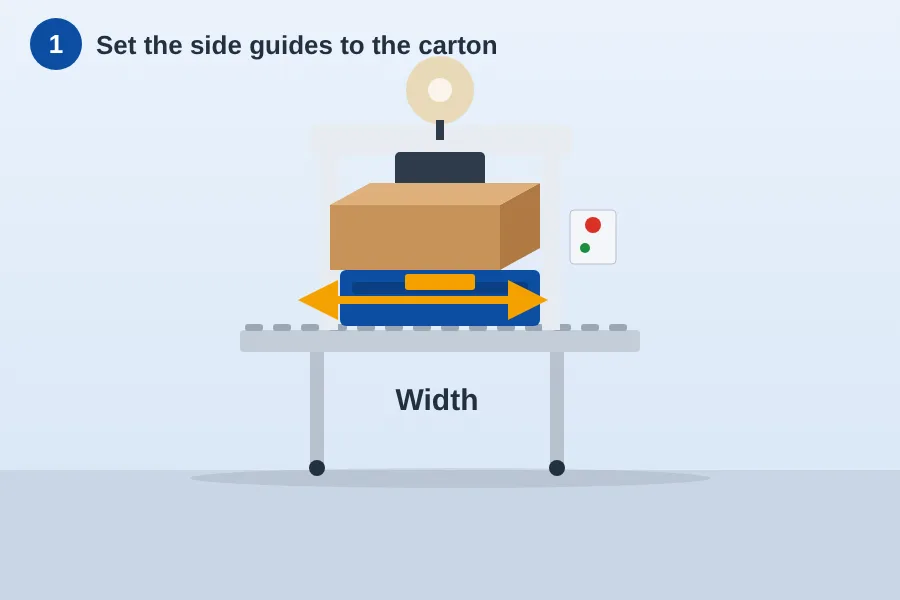
Step 3: How do you set the width?
Width is set by moving the two side guides, which carry the drive belts. Stand a closed carton between them and bring the guides in until both belts touch its sides. The box should be held square with light pressure, not squeezed.
Too wide, and the tape misses the joint. Too narrow, and the belts crush corners or stall the box. Lock it and push the carton by hand to feel the grip.
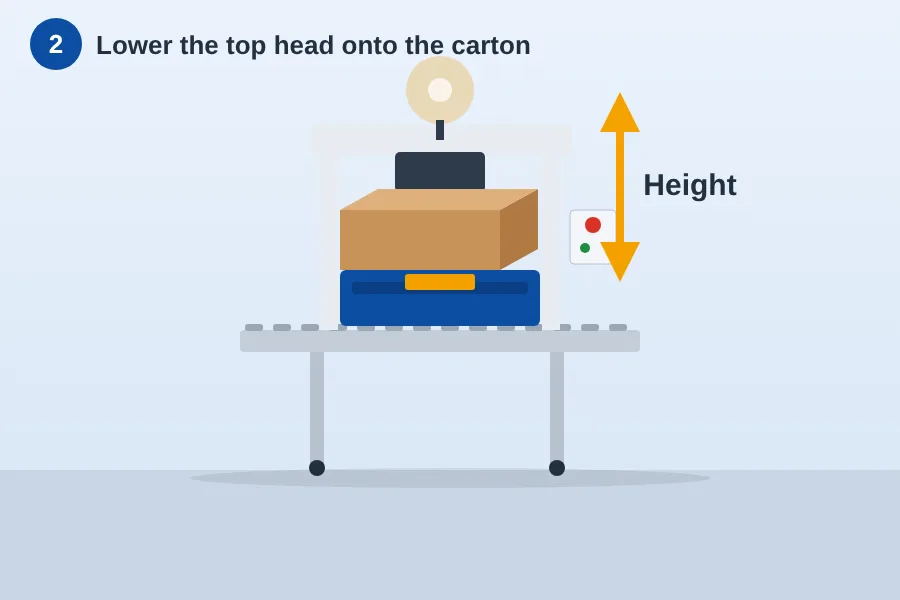
Step 4: How do you set the height of the top head?
The top head carries the upper roll and must sit at the height of the closed carton. With the box on the table, lower the head until its front roller rests lightly on the top flaps, then lock it.
Set high, the tape is not pressed down. Set low, the carton hits the head and jams. Slid under by hand, the box should pass with a gentle drag. Repeat Steps 3 and 4 at every size change, and mark your regular positions on the frame.
Step 5: How do you load BOPP tape in the tape head?
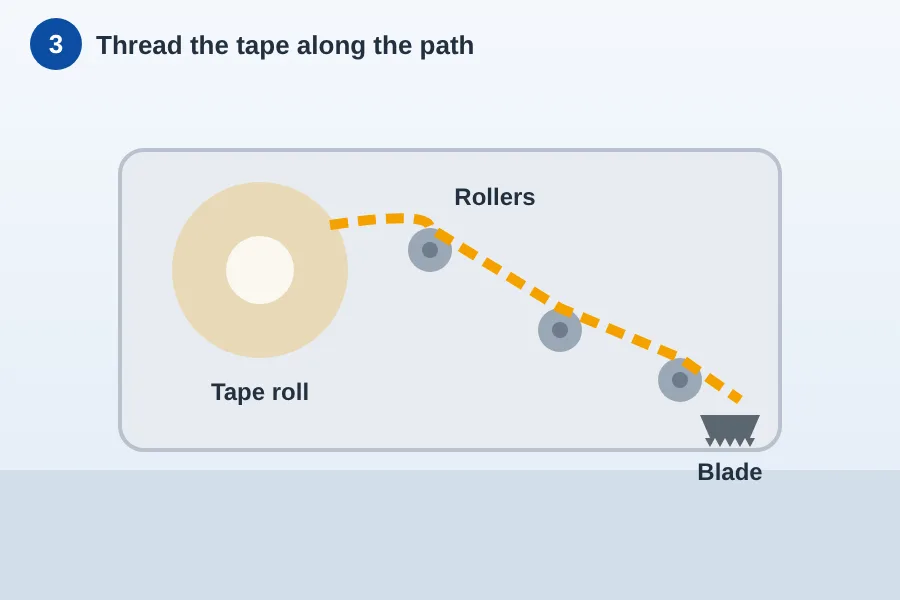
Both heads load the same way; the bottom one just sits upside down under the table. Most heads show the threading route on the side plate, so follow that drawing.
- Check the roll width suits the head. Common sizes are 48, 60 and 72 mm.
- Push the roll fully onto the hub, flat against the back plate, so the tape peels off with its sticky face towards the carton side.
- Draw out a forearm's length and lead it around the guide rollers in the marked order, smooth side against each roller.
- Take it over the tension or one-way roller, which should turn one way only.
- Bring it to the front applying roller with the glue facing outwards, towards the arriving carton.
- Leave a short tail just past the front roller, not folded back.
- Check the tape clears the cutter and the blade guard swings freely.
Short hand rolls run out quickly; PackForge sells long machine-grade BOPP tape rolls for its sealers.
Step 6: How tight should the tape tension be?
Tension is set with a knob or nut on the head, usually at the roll hub or the one-way roller. Aim for tape that lies flat without being stretched.
- Too loose: slack tape creases across the joint.
- Too tight: tape thins, pulls aside or snaps, and the ends may lift later.
- Right: a smooth flat band, cut cleanly at the back edge.
Turn the knob a quarter turn at a time and test after each change.
Step 7: Feed the first carton and check the seal
Switch on and let the belts run. Hold the carton square and slide it into the infeed until the side belts take hold, then let go. Do not shove it; a push can twist the tape. At the outfeed, inspect four points:
- Front leg: tape turns down the leading face by roughly 50 to 70 mm.
- Centre: tape covers the flap joint end to end, without creases.
- Rear leg: a similar length on the trailing face, cut square.
- Underside: the same three points on the bottom seal.
If one looks wrong, switch off and change one setting at a time.
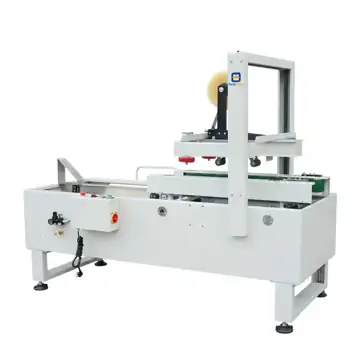
Daily checks that keep the seal neat
- With the plug out, wipe glue off the cutter teeth.
- Clear dust and tape scraps from belts and rollers, and spin each roller by hand to find any that stick.
- On air-driven models, read the gauge and drain the filter bowl.
- Shiny or cracked belts lose grip, so look at them too.
Common first-day mistakes and how to fix them
- Tape threaded wrong way round: glue faces the rollers and nothing sticks. Re-thread, sticky face out at the front roller.
- Guides left at the old size: the new carton drifts or jams. Reset at every size change.
- Pushing the box through: legs come out short and crooked.
- Flaps open at the infeed: the head catches and tears a flap.
- Tension wound right up: tape stretches and breaks.
If a fault stays, our carton sealer troubleshooting guide lists more symptoms and causes.
When should you change the blade or belts?
Go by condition. A blade is due when it still tears the tape after a proper clean; belts, when glazed, cracked or letting boxes slow down with the width set right.
The 12-month warranty is for manufacturing defects, not wear parts like these, so keep a spare blade and belt set nearby. We hold blades, rollers and belts on the carton sealer spares page; quote your model when ordering.
Step-by-step guides: carton sealer blade replacement, carton sealer belt replacement and the daily, weekly and monthly carton sealer maintenance schedule. Each model’s settings are on the carton sealing machine manual page, and this guide is also in Hindi: कार्टन सीलर कैसे चलाएँ.
How do semi automatic, random and pneumatic models differ in use?
Semi automatic machines follow every step above; the operator sets width and height once per carton size. This group covers the semi automatic carton sealing machine with top and bottom tape (₹69,730 + ₹12,551 GST), the 102TU, the 102TUS, and the compact sealer for small cartons at ₹57,500 + ₹10,350 GST.
Automatic random sealers measure each box and move the guides and top head themselves, so the operator skips Steps 3 and 4. The automatic random carton sealing machine also needs air at 5 to 6 bar.
The PackForge 102TR pneumatic carton sealer uses air to suit random sizes. Check the compressor gives the listed 2 / 3 litre at 5 bar, and shut the air valve before tape or blade work.
| Model | Width and height set by | Tape width | Power |
|---|---|---|---|
| Compact (PF-CCS-01) | Operator, per carton size | — | 230 V single phase, approx. 0.2 kW |
| Semi Automatic (PF-SAC-01) | Operator, once per carton size | — | 230 V single phase, approx. 0.24 kW |
| 102TUS | Operator, quick adjustment | 36 or 48 mm | 220 V / 50 Hz, 200 W |
| 102TU | Operator, once per carton size | 50 or 76 mm | 1 phase, 110 / 220 / 240 V |
| Automatic Random (PF-ARC-01) | Machine, measures each carton | — | 230 V single phase, approx. 0.4 kW, plus air |
| 102TR pneumatic | Machine, random sizes | 48, 60, 76 mm | 220 V / 50 Hz, 220 W, plus air |
A dash means the figure is not listed for that model. To compare types, read the carton sealing machine buying guide or the main carton sealing machine page. In Hindi: कार्टन सीलिंग मशीन की जानकारी.
Questions buyers ask
Carton sealer how to use – can a new worker learn it in a day?
Usually, yes. Setting sizes, loading tape and feeding a box are simple once shown. Supervise the first few test cartons.
Carton sealer mein tape kaise lagate hain?
Switch off first. Push the roll onto the hub, lead the tape around the rollers in the order drawn on the head, and bring it to the front roller sticky side out. Leave a short tail.
Machine mein carton phas jata hai, kya karein?
Usually the top head is too low or the side guides too tight for that size. Switch off, remove the carton and reset both for the box you are running. Fold all flaps before feeding.
How long should the tape legs be on each end?
About 50 to 70 mm down the front and back faces. Very short legs peel away in transit; very long ones waste tape.
Which tape should I use in my carton sealer?
Machine-length BOPP tape in a width your model accepts. The 102TU takes 50 or 76 mm; the 102TR takes 48, 60 or 76 mm.
Do I need an air compressor to run a carton sealer?
Only for air-driven models. The 102TR needs 2 / 3 litre at 5 bar and the automatic random model 5 to 6 bar. Semi automatic models list ordinary mains power and no air.
Need help setting up your sealer?
WhatsApp your model name and carton size to +91 95822 69346, or phone +91 98184 38346, from 9:30 AM till 6:30 PM on working days (Sunday closed). We will talk your operator through the settings. Every machine is dispatched from Faridabad, delivered free, with a GST bill.
More on carton sealing machines
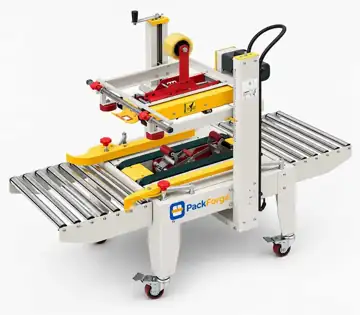 PackForge Automatic Random Carton Sealing Machine, Auto Size Adjust
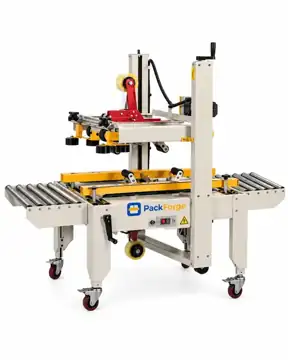 PackForge Compact Carton Sealing Machine for Small Cartons
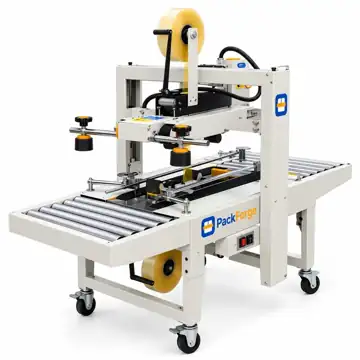 PackForge 102TR Pneumatic Automatic Carton Sealer
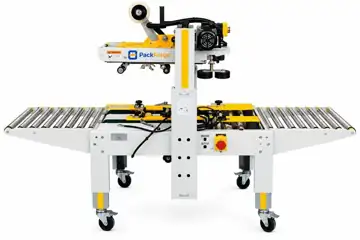 PackForge 102TU Carton Sealer (Standard Carton)
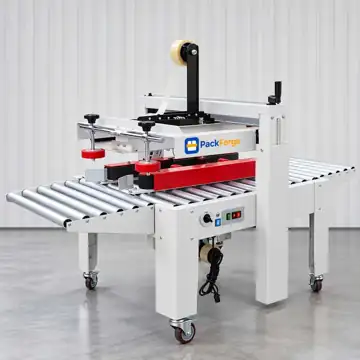 PackForge 102TUS Carton Sealer (Smaller Cartons)
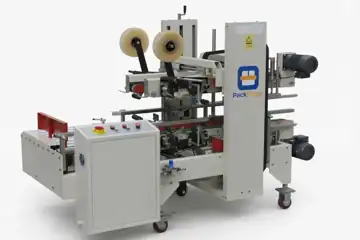 PackForge 5050J Carton Edge Sealing Machine
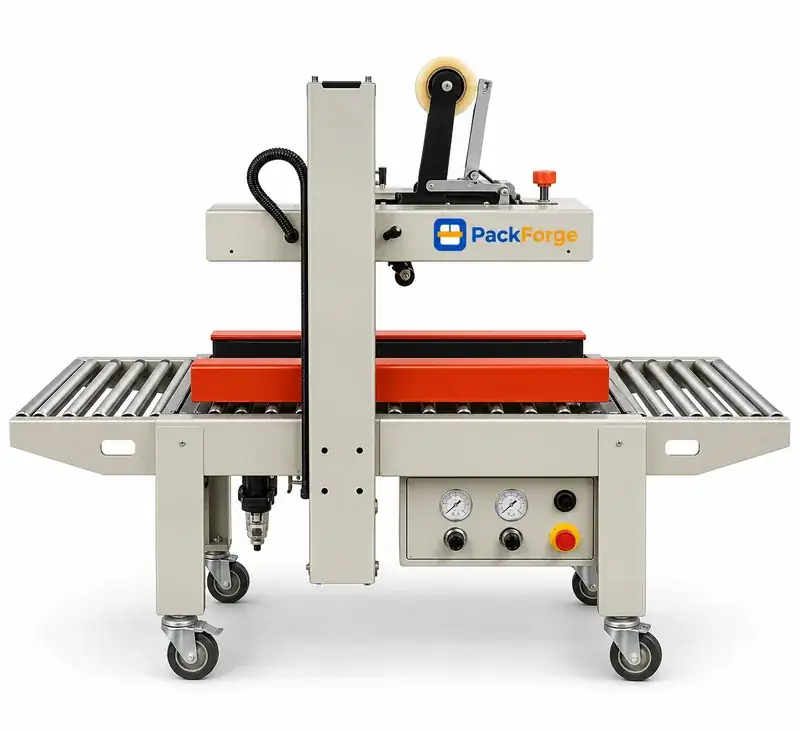 PackForge 5050Z Carton Sealer with Flap Folder